
Pedal power
Courier company takes a two-wheeled path to success
„Lock your car, pump your bike, and push it, pal!”
That’s the motto of Hajtás Pajtás Kft, Budapest’s leading bicycle courier agency. Day after day, its tanned, toned and street-grimed young cyclists dodge traffic and dog droppings to get their clients’ packages from A to B. When it comes to survival, they may not be the fastest, but they are definitely the fittest.
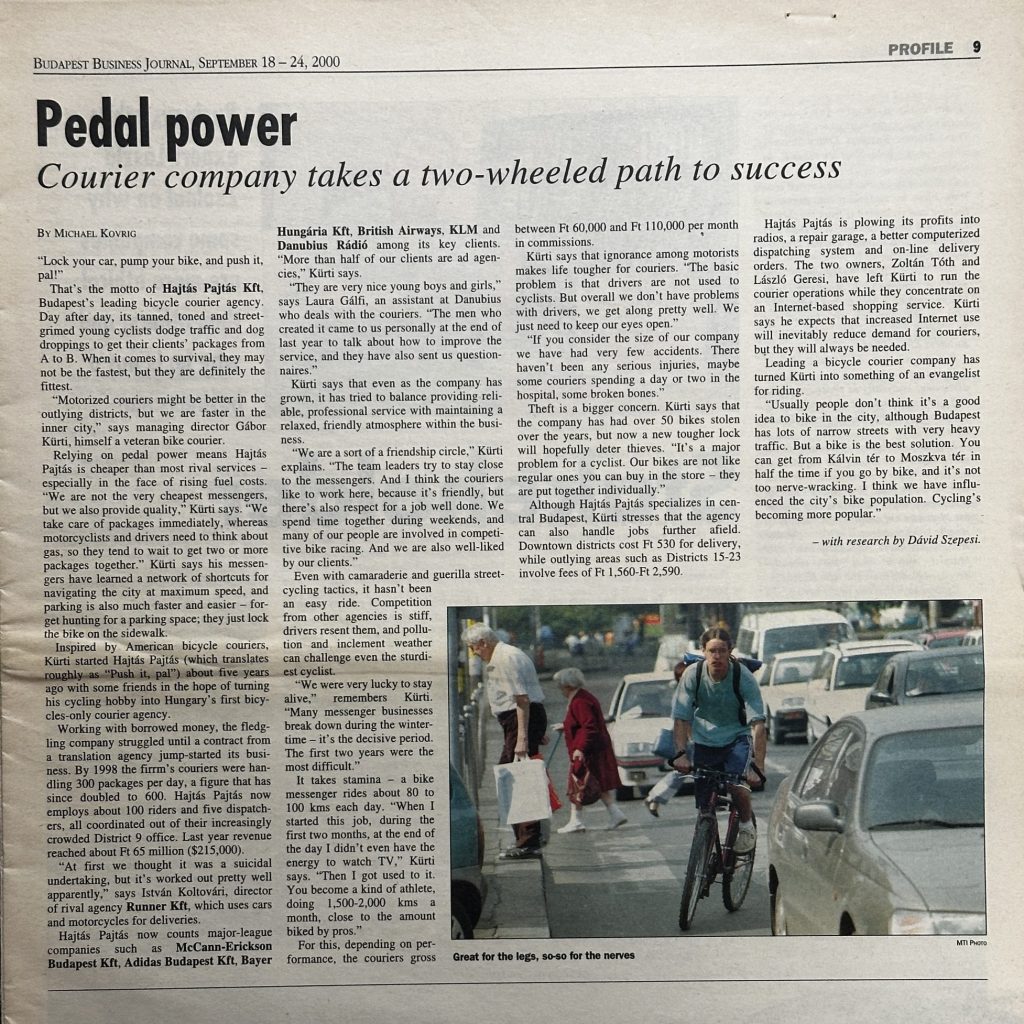
„Motorized couriers might be better in the outlying districts, but we are faster in the inner city,” says managing director Gábor Kürti, himself a veteran bike courier.Relying on pedal power means Hajtás Pajtás is cheaper than most rival services – especially in the face of rising fuel costs.
„We are not the very cheapest messengers, but we also provide quality,” Kürti says. „We take care of packages immediately, whereas motorcyclists and drivers need to think about gas, so they tend to wait to get two or more packages together.”Kürti says his messengers have learned a network of shortcuts for navigating the city at maximum speed, and parking is also much faster and easier – forget hunting for a parking space; they just lock the bike on the sidewalk.
Inspired by American bicycle couriers, Kürti started Hajtás Pajtás (which translates as „Push it, pal”) about five years ago with some friends in the hope of turning his cycling hobby into Hungary’s first bicycles-only courier agency.
Working with borrowed money, the fledgling company struggled until a contract from a translation agency jump-started its business. By 1998 the firm’s couriers were handling 300 packages per day, a figure that has since doubled to 600. Hajtás Pajtás now employs about 100 riders and five dispatchers, all coordinated out of their increasingly crowded District 9 office. Last year revenue reached about Ft 65 million ($215,000).
„At first we thought it was a suicidal undertaking, but it’s worked out pretty well apparently,” says István Koltovári, director of rival agency Runner Kft, which uses cars and motorcycles for deliveries.
Hajtás Pajtás now counts major-league companies such as McCann-Erickson Budapest Kft, Adidas Budapest Kft, Bayer Hungária Kft, British Airways, KLM and Danubius Rádió among its key clients.
„More than half of our clients are ad agencies,” Kürti says.
„They are very nice young boys and girls,” says Laura Gálfi, an assistant at Danubius who deals with the couriers. „The men who created it came to us personally at the end of last year to talk about how to improve the service, and they have also sent us questionnaires.”
Kürti says that even as the company has grown, it has tried to balance providing reliable, professional service with maintaining a relaxed, friendly atmosphere within the business.
„We are a sort of a friendship circle,” Kürti explains. „The team leaders try to stay close to the messengers. And I think the couriers like to work here, because it’s friendly, but there’s also respect for a job well done. We spend time together during weekends, and many of our people are involved in competitive bike racing. And we are also well-liked by our clients.”
Even with camaraderie and guerilla street-cycling tactics, it hasn’t been an easy ride. Competition from other agencies is stiff, drivers resent them, and pollution and inclement weather can challenge even the sturdiest cyclist.
„We were very lucky to stay alive,” remembers Kürti. „Many messenger businesses break down during the wintertime – it’s the decisive period. The first two years were the most difficult.”
It takes stamina – a bike messenger rides about 80 to 100 kms each day.
„When I started this job, during the first two months, at the end of the day I didn’t even have the energy to watch TV,” Kürti says. „Then I got used to it. You become a kind of athlete, doing 1,500-2,000 kms a month, close to the amount biked by pros.”
For this, depending on performance, the couriers gross between Ft 60,000 and Ft 110,000 per month in commissions.
Kürti says that ignorance among motorists makes life tougher for couriers.
„The basic problem is that drivers are not used to cyclists. But overall we don’t have problems with drivers, we get along pretty well. We just need to keep our eyes open.
„If you consider the size of our company we have had very few accidents. There haven’t been any serious injuries, maybe some couriers spending a day or two in the hospital, some broken bones.”
Theft is a bigger concern. Kürti says that the company has had over 50 bikes stolen over the years, but now a new tougher lock will hopefully deter thieves.
„It’s a major problem for a cyclist. Our bikes are not like regular ones you can buy in the store – they are put together individually.”
Although Hajtás Pajtás specializes in central Budapest, Kürti stresses that the agency can also handle jobs further afield. Downtown districts cost Ft 530 for delivery, while outlying areas such as Districts 15-23 involve fees of Ft 1,560-Ft 2,590.
Hajtás Pajtás is plowing its profits into radios, a repair garage, a better computerized dispatching system and on-line delivery orders. The two owners, Zoltán Tóth and László Geresi, have left Kürti to run the courier operations while they concentrate on an Internet-based shopping service. Kürti says he expects that increased Internet use will inevitably reduce demand for couriers, but they will always be needed.
Leading a bicycle courier company has turned Kürti into something of an evangelist for riding. „Usually people don’t think it’s a good idea to bike in the city, although Budapest has lots of narrow streets with very heavy traffic. But a bike is the best solution. You can get from Kálvin tér to Moszkva tér in half the time if you go by bike, and it’s not too nerve-wracking. I think we have influenced the city’s bike population. Cycling’s becoming more popular.”
Ez a cikk független sajtó megjelenés